Job exposure is not job loss
Global employment · ILO / NASK 2025. The second group is within the first, not an additional share. Redrawn from reported data.
Source ↗No matching sources. Reset filters to see the library.
Video studio · Phase 2 · checked 20 Nov 2026
The checked evidence does not support a simple “AI will take every job” or “AI will create every job.” Our working interpretation is mixed and partial: task reallocation, faster work inside exposed roles, selective AI-linked demand, and possible pressure on the junior pipeline that teaches people how to become senior.
Entry-level and routine white-collar work is the pressure point: first drafts, summaries, QA, L1 support, operations, research assistants and apprenticeship tasks. The risk is not only unemployment. It is a broken ladder.
Most evidence shows tasks moving before job titles disappear. Employers still hire, but they ask for judgment, tool use, domain context, verification and ownership earlier than before.
Platform postings suggest AI/ML and some fresher demand are growing, while AI-embedded work spreads. Postings are not realised jobs, so the opportunity is real but uneven and unproven.
AI and Young India
├─ What is measured
│  ├─ Employer postings: IMF finds nearly 10% lower relative demand in more exposed occupations after ChatGPT. Postings are not jobs lost.
│  ├─ Indian IT: MeitY cites NASSCOM’s net-hirer estimate; NITI’s roadmap flags routine junior QA and L1 support risk.
│  ├─ Platform hiring: Naukri’s October index says white-collar +14% YoY, AI/ML +32%, fresher +15%, IT/software +5%, with a soft-base caveat.
│  ├─ Firm survey: ICRIER finds entry-level moderation, while exposed technical/analytical roles show the strongest reported demand growth.
│  └─ Skilling: YUVA’s 1 crore target and IICT’s Aug 12 Phase I snapshot are separate programmes; the snapshot is not a dropout rate.
├─ What is exposed
│  ├─ Routine digital tasks: first drafts, summaries, research, QA, support and operations.
│  ├─ Junior apprenticeship: CeRAI frames the first-rung pipeline as especially vulnerable.
│  ├─ Physical work: Anthropic’s US physical-task model shows high technical capability, mostly in limited or controlled settings, but only 0.3% cost-competitive today.
│  └─ Inequality: access to tools, English, computing, mentors and better firms changes who benefits.
├─ What is growing
│  ├─ AI/ML roles and AI-embedded jobs.
│  ├─ Enterprise AI, frontier AI, governance, evaluation and deployment work.
│  ├─ Productivity for people who can direct, verify and own AI output.
│  └─ New business formation where one person can do more with agents.
├─ What is uncertain
│  ├─ How fast Indian firms will adopt frontier workflows.
│  ├─ Whether training becomes placement and income.
│  ├─ Whether junior work is redesigned or simply removed.
│  └─ Whether access spreads beyond urban enterprise users.
└─ The choice
   ├─ Let the first rung collapse.
   └─ Rebuild it: task portfolios, apprenticeships, public access, verified skills and junior roles with real ownership.
Anthropic’s recent videos use warm documentary footage, off-white title cards, black serif chapter type, small lowercase prompts, restrained diagrams and sparse green highlights. The exact frames below are reference stills only. Do not publish them as reusable footage.
Confirmed current Anthropic website fonts are Anthropic Sans, Anthropic Serif and Anthropic Mono from live CSS. The actual video overlay font is not confirmed; use a close open alternative for reconstruction. Candidate: Fraunces or Source Serif for chapter cards; Inter or IBM Plex Sans for UI; IBM Plex Mono for evidence labels.
Warm ivory, black, muted green and natural skin tones. Slow interview shots, fast evidence montage, cream diagram plates, ink circles, node trees and screen recordings. Avoid glowing robots, purple gradients and stock “AI brain” clichés.
These stills are for style analysis. Timecodes are our observations from this pass and are not independently validated. Rights remain with Anthropic and the video contributors. Source videos: What we make of this moment, The making of Anthropic, Introducing Claude Fable 5.1.




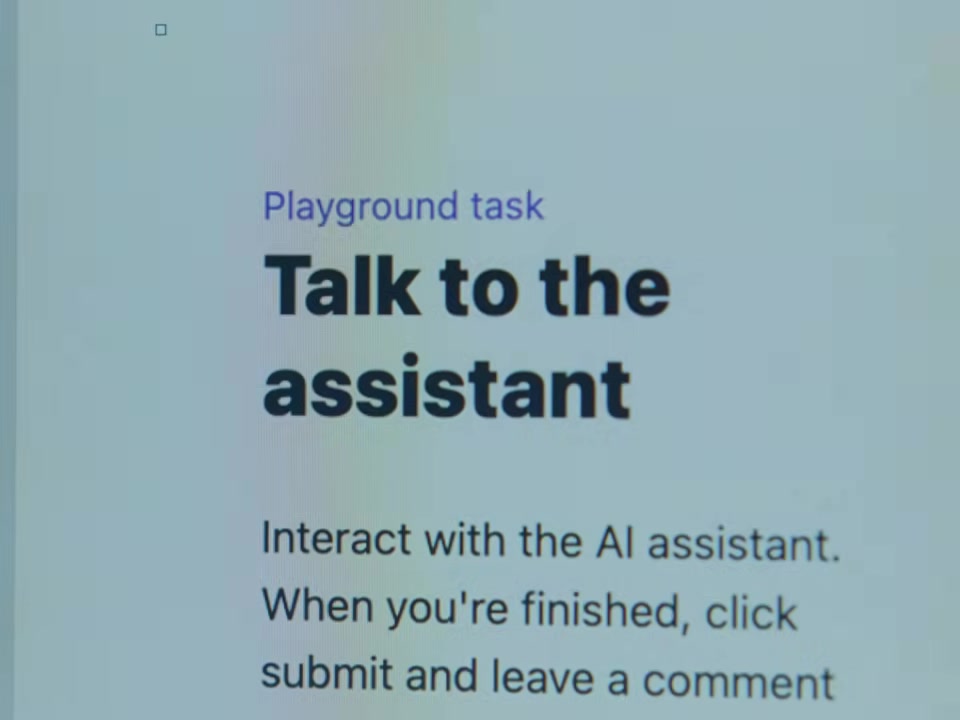
| Source | Observed frame | Text/type | Effect | Rebuild for this film |
|---|---|---|---|---|
| Moment 00:05 | lab vial and close handwork | small lowercase “Can” over footage | documentary shallow focus, no flashy transition | Indian lab, classroom or office close-up; one verb only |
| Moment 00:10 | extreme close-up, face and light | large lowercase “second?” | type appears as part of the cut, not as a caption bar | use a real job screen or trainee face; one short question |
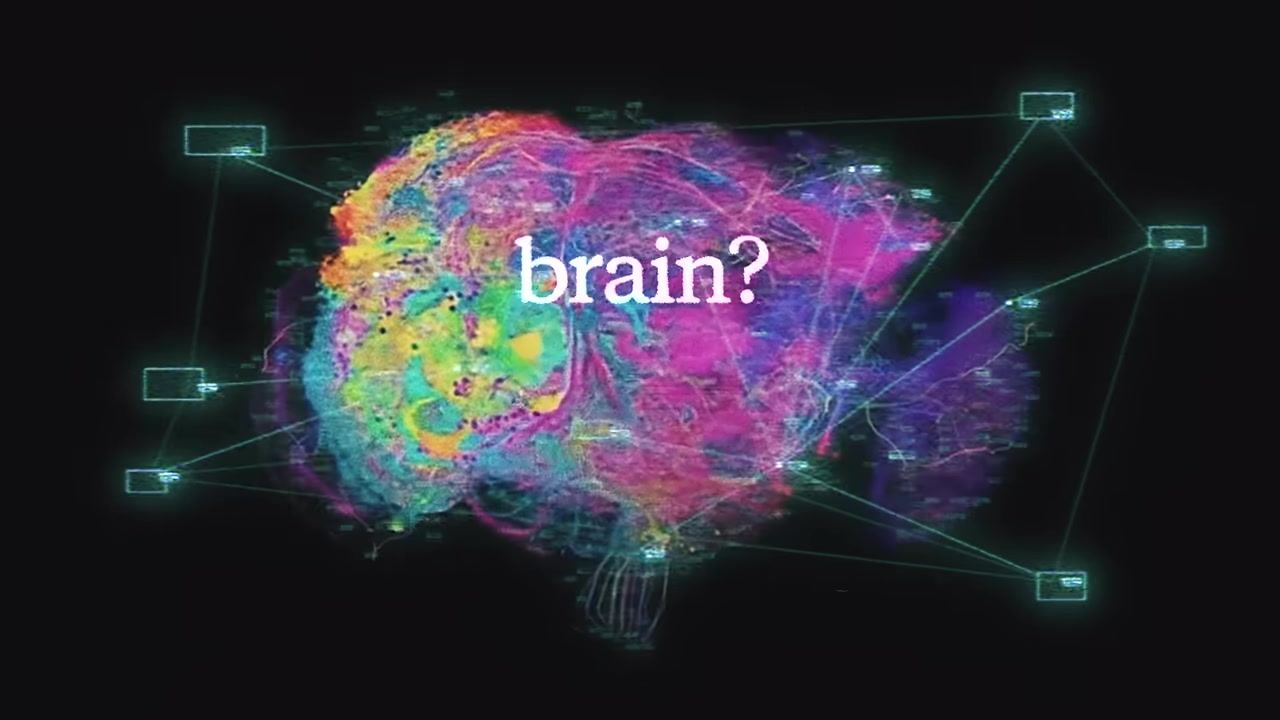
| Moment 00:18 | networked brain visual | small lowercase “brain?” | scientific macro image with restrained glow | replace with original network/task diagram; avoid stock AI brain |
| Moment 00:23 | helicopter and suspended load | small “the” on sky | single word held against action footage | use sparse verbs over Indian work and infrastructure footage |
| Moment 01:01 | off-white card | small black sentence | quiet full-screen pause after fast montage | use for thesis card: “The first rung is changing.” |
| Fable 00:31 | cream radial node diagram | minimal UI labels, sparse green active node | flat vector diagram with soft edges | map “job title → tasks → exposure → new skill” |
| Fable 01:20 | black circular data field | tiny labels and one highlighted node | dark microscope-like information plate | show the dated IICT Phase I snapshot 60,253 → 4,620 → 552 as a cohort flow, never as a dropout-rate funnel |
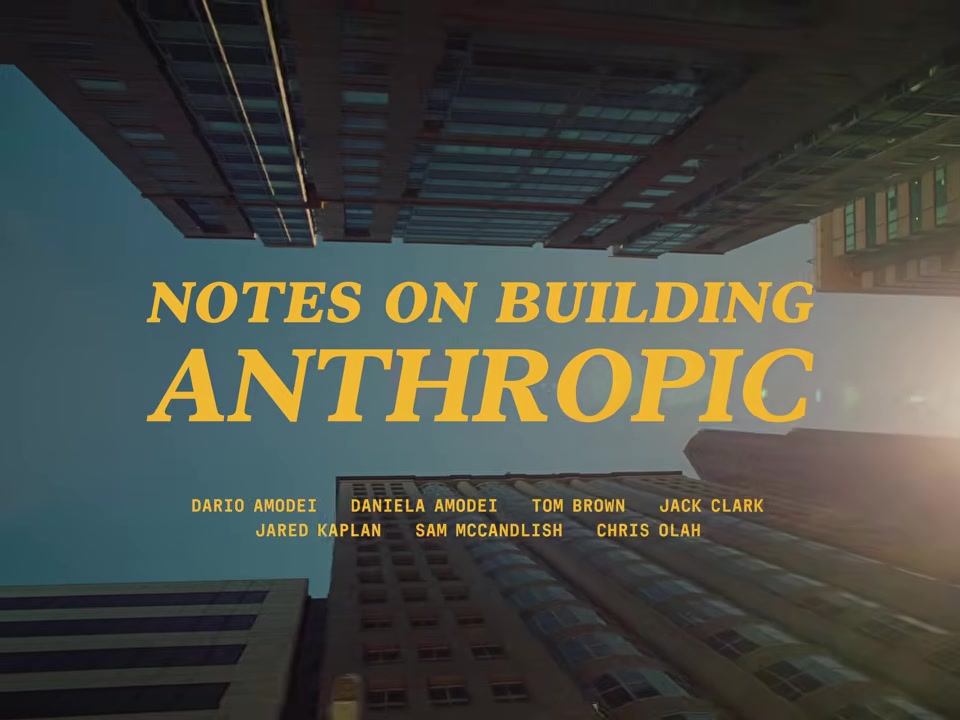
| Making 00:20 | large archival wall card | yellow serif “NOTES ON BUILDING ANTHROPIC” | physical object filmed at an angle | print or build evidence cards, then film/scan them |
| Making 02:30 | ivory chapter card | large black serif “Scaling Laws” | hard cut, centered type, generous space | chapter cards: “Tasks”, “First Rung”, “Skilling”, “Choice” |
| Making 04:30 | glitching archival display | yellow pixel/condensed “TIME TO BUILD THIS THING” | intentional old-screen distortion | use only once for urgency; keep body film clean |
Font status: Anthropic Sans/Serif/Mono are confirmed for the current website CSS, not for these video overlays. Treat Fraunces, Source Serif, Inter, IBM Plex Sans and IBM Plex Mono as close open-source reconstruction choices, not confirmed matches.
Hardware context: Pentium G2030-class desktop, 12GB DDR3, SSD, Linux transition in progress. No paid trials, no card requirements, no new account mutation. Official pages control these claims; practitioner threads are only leads.
Item pages still need a fresh license check immediately before download and publication. Pexels, Pixabay and Unsplash allow broad free use with restrictions; Mixkit licenses vary by item type; NASA imagery has acknowledgement and logo/endorsement limits.
| Candidate | Use in film | Observed item facts | License check |
|---|---|---|---|
| Pexels: Woman Using a Laptop | opening job-search or remote-work portrait | Page-described Indian woman, bright office, 0:34, 1080x1920 | Pexels license; do not imply endorsement or resell unaltered. |
| Pexels: India call-centre office | service-sector scale and back-office context | Page-described India office, 0:34, 1920x1080, 25fps | Pexels license; check recognisable people and brand marks before use. |
| Mixkit: Indian Woman Working at Desk | young professional B-roll | 0:14, 24fps, vertical options | Mixkit license; conditional candidate only, not fully cleared until the item license text is rechecked before download. |
| Mixkit: Man working on his laptop | spreadsheet, analysis and task-work insert | 0:21, Full HD listed, 24fps | Mixkit Stock Video Free License listed on item page; recheck before download. |
| Pixabay: Students, books, papers | learning, group project and apprenticeship context | students at a desk with papers and computer | Pixabay Content License; no standalone redistribution or misleading use. |
| Pixabay: Typing, computer, working | generic task-work close-up | MP4, 1920x1080 listed | Pixabay Content License; check trademarks and recognisable people. |
| Unsplash stills and NASA imagery | chapter-card texture, science macro or space/compute metaphor | no final item selected yet | Use only after selecting an item and saving its exact page/license URL. |
Open the five-script draft page
Human, emotional, evidence-led. A graduate, a changed task list and the apprenticeship problem. Core sources: CeRAI, ICRIER, MeitY/NASSCOM, IMF.
Explainer. Take five Indian job titles apart and show which tasks are exposed, complemented or transformed. Core sources: CeRAI, MeitY/NITI roadmap, Anthropic robotics comparison.
Two programmes, one discipline: do not merge targets, snapshots, credentials, learning and job outcomes. Core sources: NITI, PIB, Sansad, Virmani.
Anthropic case study. IPO scale, agent-hours, expectations gap and robotics economics, with strict caveats. Core sources: SEC 424(b)(4), Anthropic research.
Practical closing film. Domain plus AI, proof of work, local problems, portfolio, apprenticeships and the public access a young worker needs. Core sources: Quess, Naukri, NITI, Sansad, Virmani.
Five full script drafts are kept on the linked scripts page. Each has a spoken-word runtime estimate, a distinct structure and production directions. They still need final proofing and mobile visual verification before publication acceptance.
Prepared for the existing AI & Young India research hub. This page preserves the original library and adds a production lane; it does not replace or redesign the original work.
AI & Young India · five distinct long-form script drafts · checked 20 Nov 2026
Human, emotional, evidence-led. The first-rung and apprenticeship problem.
Spoken-word estimate: 1,799 words, about 13.3-15.0 minutes at 135-120 wpm before deliberate pauses. Method: headings, visual directions and citations removed before counting.
Clear explainer. Job titles split into task bundles across Indian roles.
Spoken-word estimate: 1,723 words, about 12.8-14.4 minutes at 135-120 wpm before deliberate pauses. Method: headings, visual directions and citations removed before counting.
Two programmes, one discipline. Targets, snapshots, learning and real capability.
Spoken-word estimate: 1,773 words, about 13.1-14.8 minutes at 135-120 wpm before deliberate pauses. Method: headings, visual directions and citations removed before counting.
Financially careful frontier case study. Anthropic IPO and research with strict units.
Spoken-word estimate: 1,714 words, about 12.7-14.3 minutes at 135-120 wpm before deliberate pauses. Method: headings, visual directions and citations removed before counting.
Direct practical guide. Domain plus AI, proof of work and a seven-day start.
Spoken-word estimate: 1,651 words, about 12.2-13.8 minutes at 135-120 wpm before deliberate pauses. Method: headings, visual directions and citations removed before counting.
Script 1 · spoken-word estimate 1,799
Target: about 12-15 minutes of natural spoken delivery, measured by spoken words only plus deliberate pauses.
Style: calm, human, evidence-led. Speak to one person, not a crowd.
[Visual: a phone screen in a dark room. A job page loads slowly. Cut to an empty chair at a small desk.]
Picture a young graduate in India tonight.
They have done the things people told them to do. School. College. Maybe a certificate. Maybe a coding course. Maybe a degree that took money the family did not easily have.
They open a job page.
The job is still there. The title has not disappeared. It says analyst. Or associate. Or trainee. Or support executive.
But look one level deeper.
The work under that title is changing. The first draft is written by AI. The first summary is written by AI. The first test case is generated by AI. The first customer reply is suggested by AI. The research note that used to take a junior all afternoon now appears in thirty seconds.
The job title survives.
The learning work inside it is being removed.
That is the story worth slowing down for. The familiar debate jumps between two slogans: robots take all jobs, or AI creates more jobs. The real question is narrower and much more important:
What happens when the first rung of the ladder changes before young India gets to climb it?
[Visual: one job title on a cream card. It splits into task cards.]
A job sounds like one thing.
“Content writer.”
“QA engineer.”
“Business analyst.”
“Customer support associate.”
“Junior designer.”
But a job is not one thing. It is a bundle of tasks.
Some tasks are repetitive. Write the first draft. Sort the tickets. Summarize the meeting. Make the basic test case. Pull the data. Check the format.
Some tasks carry judgment. Decide what the client meant. Notice when the answer is wrong. Handle the angry person. Know what matters in this office, this city, this market.
And some tasks are practice. They look boring from the outside, but they teach the junior person how the work actually happens.
This is why the phrase “AI exposure” can mislead us. A job can be highly exposed and still exist. A job can look safe on paper and still lose the part that trained the beginner.
IIT Madras CeRAI’s India report makes this task-level point clearly. The unit is not the job title. The unit is the task bundle. The report warns that junior apprenticeship tasks are especially exposed. [154].
Junior jobs can remain on the page while the path into skilled work becomes thinner. The headline count can look stable even when the beginner’s route has changed.
[Visual: three evidence cards, one at a time. Keep the numbers large and quiet.]
Now let’s stay with what is measured.
First, ICRIER surveyed 651 IT firms in ten cities between November 2025 and January 2026. It did not find evidence of mass job loss. It found moderation concentrated at the entry level, while the occupations most exposed to AI, especially technical and analytical roles, showed the strongest reported demand growth. [18]
That is a mixed signal, not a collapse story and not an all-clear. The pressure is at the entry point, even where employers still value advanced technical work.
Second, MeitY told Parliament that Indian IT remains a net hirer. Citing NASSCOM, it put industry employment at about 60 lakh in FY2025-26, with 1.35 lakh professionals added. The same answer also named routine junior QA and L1 support as areas facing reduction risk. [160].
Overall growth can conceal a changing entry point. The industry can add people while offering fewer of the old junior tasks.
Third, Naukri’s October 2026 platform index shows white-collar hiring up 14 percent year on year, with AI/ML up 32 percent and fresher hiring up 15 percent. IT and software services were up 5 percent. Naukri also warns that a soft festive base lifted the October headline. [49]
These are new listings and recruiter resume searches, not realised employment. Still, they complicate a simple collapse story: AI-linked demand and some fresher segments were growing on the platform even while the first-rung problem remained.
So the evidence does not say, “There are no jobs.” It is mixed and partial: postings are not employment, and surveys are not destiny. But it does show the old entry route changing faster than the institutions around it.
[Visual: world map fades to Asia. A job-postings chart appears.]
You may hear a dramatic line: “AI caused a 10 percent fall in jobs.”
Do not say it that way.
The IMF’s October 2026 Asia and Pacific report looked at about 40 million online job postings across 19 Asian economies through April 2026. It found that employer demand fell nearly 10 percent in more AI-exposed occupations relative to less-exposed occupations after ChatGPT. [155].
That is useful evidence, provided we keep it inside its limits.
It is about online job postings, not everyone’s employment. It compares more exposed occupations with less exposed ones. It is a relative pattern after a technology shock, not proof that AI alone caused every change.
But for a young person trying to enter the market, postings matter. A posting is a door. If there are fewer doors in the kind of work you trained for, you feel that before an annual employment report explains it.
[Visual: a staircase. The bottom step fades, then redraws as a different shape.]
Here is the heart of the problem.
Senior workers are not born senior. They become senior by doing junior work.
The junior analyst writes a rough note and learns why it is wrong.
The junior developer fixes a small bug and learns how the system fits together.
The junior designer makes ten bad layouts and slowly develops taste.
The junior support agent hears a confused customer and learns what the manual never says.
If AI does the rough note, the small bug, the basic layout and the first reply, companies may become more productive. But who is learning?
This is not an argument against AI. It is a case for redesigning apprenticeship before the old route disappears by default.
A company cannot simply say, “We no longer need juniors, only seniors with judgment.” Where do those seniors come from?
A college cannot simply say, “We added an AI module.” Did the student use AI on a real task? Did someone check the output? Did the student learn when not to trust it?
And a young worker cannot carry this alone. If every employer wants experience but fewer employers provide the work that creates experience, the system is privatizing the cost of training and leaving the bill with the family.
That is the missing first rung.
[Visual: bright but restrained. A map of roles grows from one person.]
Now the opportunity side.
The same technology that removes routine work can give one person unusual power.
A nurse who understands AI can check discharge summaries faster.
An accountant can test more cases instead of copying numbers.
A teacher can prepare examples for different levels.
A designer can explore twenty directions before choosing two.
A small business owner can answer customers, track stock, write listings and analyze sales without hiring a full office.
A young researcher can move from reading papers to testing ideas.
The opportunity is not only “become an AI engineer.” Most people will not, and should not, do that.
The larger chance is the person who understands a real domain and can direct the tool inside it. The final video turns that into a practical map. This film stays with the apprenticeship problem: how a beginner gets enough real work to become trustworthy.
[Visual: split screen. One side has a good laptop, quiet room, fast internet. The other has a shared phone, noise, limited data.]
But opportunity is not evenly distributed.
Two young people can hear the same advice: “Learn AI.”
One has a laptop, fast internet, English confidence, a mentor, a quiet room and parents who can support another unpaid internship.
The other has a shared phone, patchy data, family work, a college with old labs and no one in their circle who knows what a prompt is.
The advice is the same. The starting line is not.
This is why public access matters. Not only courses. Access to tools, computing, mentors, real projects and recognized proof of work.
Government documents show ambition. The PIB says more than 65 percent of India is under 35. [157]. A separate PIB feature describes YUVA AI for All, a free national AI literacy course aiming at foundational AI proficiency among 1 crore citizens. [166].
That target belongs to YUVA AI for All. A parliamentary answer on the separate National AI Skilling Initiative gives a dated Phase I snapshot: as of August 12, it recorded 60,253 applications or enrolments, 4,620 people completing two modules, and 552 completing all four modules of a 33-hour course. [159]. That is not a dropout rate, but it shows why completion cannot be assumed.
That does not mean the programme failed. It means we should look at the whole funnel. Signing up is easy. Finishing is harder. Turning completion into work is harder still.
[Visual: the broken staircase is rebuilt with labelled steps.]
If the first rung is changing, we have to rebuild it on purpose.
First, make task portfolios normal. A young worker should be able to show: here is the brief, here is what AI produced, here is what I changed, here is what I caught, here is the final result. That is better proof than a line saying “familiar with AI tools.”
Second, redesign junior roles. Do not pretend the old routine work still needs to be done slowly by hand. Give juniors real responsibility with review: check AI output, compare sources, speak to users, test edge cases, document decisions.
Third, connect training to work. A course should end in a task someone outside the course can inspect. Not a badge for watching videos.
Fourth, use public infrastructure. Libraries, colleges, skill centres and digital public systems can give shared access to tools and compute for people who cannot buy their way in.
Fifth, measure outcomes. Not only enrolments. Completion. Placement. Wages. Retention. Whether a person moved from task executor to trusted reviewer.
None of this asks us to reject the technology. It asks us to put young people back into the design.
[Visual: simple checklist, no hustle-culture graphics.]
If you are young and watching this, the answer is not panic.
Pick one field you actually care about. Watch how its work really gets done: the draft, the check, the exception, the client question, the final decision. Then build proof around one real task.
Not “I know AI.”
Show one project.
Show the source.
Show the AI output.
Show your correction.
Show the final decision.
In a market where first drafts are cheap, judgment becomes visible.
[Visual: return to the first phone screen. This time the job page is open beside a task portfolio.]
So, is AI a threat to jobs or an opportunity for young India?
The honest answer is: the old ladder is under pressure, and a new one is possible only if we build it on purpose.
A job can disappear. A quieter danger is that the job survives, but the young person never gets the work that would have taught them how to become good at it.
The opportunity is not automatic. It depends on access, training, employers, public systems and proof of skill.
India’s youth dividend is not a gift waiting to be collected. It is a design problem with a deadline.
And the question for every college, company and policymaker is simple:
If AI can do the first draft, what will you give the beginner so they can still become the expert?
[End card: “AI is changing the first rung, not just the job count.”]
Script 2 · spoken-word estimate 1,723
Target: about 12-15 minutes of natural spoken delivery, measured by spoken words only plus deliberate pauses.
Style: clear explainer. Use concrete examples, not jargon.
[Visual: a plain cream screen. One job title appears: “Software Engineer.” Then it splits into twelve task cards.]
When we ask whether AI will take jobs, we often imagine a job as a single object.
A software engineer.
A designer.
A support executive.
An analyst.
A teacher.
AI arrives, and the object either survives or disappears.
But that is not how work changes.
A job is not a single object. It is a bundle of tasks. Some tasks are repeated every day. Some require judgment. Some need trust. Some need physical presence. Some are done because they teach the beginner how the real system works.
AI does not enter through the job title.
It enters through the task list.
That is the difference between a lazy prediction and a useful one.
[Visual: five empty columns: first draft, search, check, decide, own.]
Take almost any knowledge job and ask five questions.
Who makes the first draft?
Who searches and summarizes?
Who checks the output?
Who decides what matters?
Who owns the result when something goes wrong?
AI is strongest at the first two. It can draft, summarize, translate, classify, extract, generate and compare. It is getting better at checking too, but checking still needs context.
The last two are different. Deciding what matters and owning the result are human responsibilities inside a real organization. AI can advise. It cannot be accountable in the same way.
This is why two people with the same job title can have completely different AI exposure.
One accountant spends the day copying data into sheets.
Another spends the day speaking to clients, judging risk and signing off.
One designer makes endless resize versions.
Another understands the user, the brand, the constraint and the tradeoff.
One software engineer writes boilerplate.
Another designs systems, reviews edge cases and owns production failures.
Same title. Different bundle.
[Visual: a desk with a spreadsheet, a report and a chat window.]
Let’s start with a junior analyst.
The old bundle might look like this:
Collect data.
Clean it.
Make a chart.
Write a first note.
Summarize three reports.
Send the draft to a senior.
AI can help with every one of those tasks. It can clean a table, suggest a chart, draft the note and summarize the reports.
So does the analyst vanish?
Not necessarily. But the junior analyst who only knows how to produce the first draft is exposed. The analyst who can ask a better question, check the source, spot the bad assumption and explain the chart to a manager becomes more valuable.
The task that changes is the first draft.
The task that rises in value is verification.
That is the pattern to watch.
When the first draft becomes cheap, the person who can say, “This looks fluent but it is wrong,” becomes important.
[Visual: a support inbox. AI suggested replies appear beside real customer messages.]
Now customer support.
AI can answer routine questions. It can draft a polite reply. It can translate. It can summarize the ticket history. It can suggest the next action.
That is real productivity.
But support is not only a text problem. A customer may be angry. A refund may be blocked by policy. A small business may be losing money. A medical or financial answer may carry risk.
The human task becomes exception handling, empathy, escalation and accountability.
MeitY’s parliamentary answer cites NASSCOM’s estimate that Indian IT remains a net hirer, and cites NITI Aayog’s roadmap naming routine L1 support as a reduction-risk area. [160]. That combination is the story. The routine layer is under pressure. The trusted human layer does not automatically disappear.
For a young worker, the advice is not “avoid support.” It is: do not remain only a script reader. Learn the product, the customer, the escalation path and the data. Move from replying to resolving.
[Visual: code editor, tests running, bug report.]
Software is not one task either.
AI can generate boilerplate. It can suggest tests. It can explain an error. It can refactor a small function. It can write documentation.
That changes the beginner’s work.
The junior developer who is asked only to type code from a ticket is exposed. The junior developer who can read the system, write a failing test, compare outputs, review AI code and explain the risk is learning a stronger skill.
The NITI Aayog roadmap cited in that answer names routine junior QA as a reduction-risk area. [160]. That makes sense. Repetitive test cases are exactly the kind of task AI can help generate.
But quality is not the same as test generation. Quality is knowing what to test, what failure would cost, which user flow matters and when a technically correct answer is still the wrong product decision.
The first rung should move from “type more tests” to “understand why this test matters.”
[Visual: a design canvas with many variants, then one selected frame.]
AI can generate images, layouts, scripts, captions and rough cuts.
That does not make taste free.
A designer still has to understand the audience, the constraint, the culture, the brand and the purpose. A video editor still has to know why one pause works and another feels dead. A writer still has to know what is true, what is clear and what should not be said.
The tool can produce twenty options. The human has to choose the two worth showing.
This is why the creative opportunity is real but uneven. AI can help a young creator do work that once needed a team. But it also floods the market with average output. The value moves toward people with taste, judgment, rights awareness and a recognizable point of view.
[Visual: warehouse, farm, clinic, construction site. Then a cost chart.]
It is easy to watch a software demo and assume every kind of work will change at the same speed.
Physical work is different.
Anthropic’s robotics research estimates that robots can perform 74 percent of US physical tasks, covering 34 percent of working hours, mostly in limited or controlled settings. Robots are cost-competitive for only 0.3 percent of work today. [152].
That gap matters.
Technical capability is not the same as economic deployment. A robot may be able to do a task in a controlled setting and still be too expensive, too fragile, too slow or too hard to maintain for the real world. The report’s 40-year path to 10 percent cost competitiveness assumes past price declines continue; it is not a forecast.
For India, the near-term pressure is stronger in digital tasks than in every physical job. But over time, hardware costs can fall. The point is not comfort. The point is timing. Different task bundles will change at different speeds.
[Visual: a map of India with enterprise hubs, small towns, campuses and small businesses.]
AI does not diffuse evenly.
A large company in Bengaluru may deploy agents across support, analytics and engineering. A small firm in Indore may use a cheap tool for invoices and customer messages. A government office may use translation. A college may ban the same tool a company expects students to know.
CeRAI’s India report is useful here because it separates cheap, good-enough AI from frontier-dependent uses. [154]. Cheap tools can spread widely through bookkeeping, BPO, MSME quality checks and office work. Frontier-dependent uses are more likely to remain concentrated in urban enterprise settings.
So the future is not one India.
It is many speeds at once.
A young person’s exposure depends on sector, firm size, city, language, internet access, manager behavior and whether their work is measured by output or presence.
That is why a national debate that says only “AI will take jobs” or “AI will create jobs” misses the texture. The task bundle tells you where to look.
[Visual: a notebook page. Write the job title, then four boxes.]
Here is a simple exercise.
Write your current job, or the job you want, at the top of a page.
Now make four boxes.
In the first box, list tasks AI can already draft or speed up.
In the second, list tasks where a human still has to verify.
In the third, list tasks where trust, context or presence matters.
In the fourth, list tasks that teach you something valuable.
Do this honestly.
A student may discover that half their “career plan” is actually a bundle of first-draft tasks. That is frightening, but useful. It tells you what to move away from and what to build toward.
A manager may discover that the company has been calling people “junior” while using them as cheap output machines. That is also useful. It tells you why the pipeline breaks when the output becomes automated.
A policymaker may discover that a course teaches tool awareness but not verification. That tells you why a certificate does not become a job.
There is also a personal benefit. Once the tasks are visible, the next step becomes less mystical. You may need to learn data cleaning, but not every AI tool. You may need client judgment, but not another generic prompt list. You may need a portfolio piece that proves verification, not a tenth certificate.
The task audit turns fear into a map.
There is a counterargument worth taking seriously: maybe companies will simply create new junior tasks we cannot yet name. That has happened before with spreadsheets, search and software. The mistake would be to assume the new tasks arrive automatically or reach everyone equally. A technology can create new work in one place while leaving a cohort stranded in another. The task audit is useful because it does not predict the future. It shows where the present is already moving.
[Visual: a simple four-part checklist.]
If you are a young worker, build four kinds of strength.
First, domain knowledge. Know the real work. AI is more useful when you understand the field it is helping with.
Second, tool control. Learn how to ask, iterate, compare, verify and document. Do not just accept the first output.
Third, judgment. Practice spotting the wrong assumption, the missing source, the weak chart, the unsafe claim and the answer that sounds confident but should not be trusted.
Fourth, proof. Keep a portfolio of tasks. Show the before and after. Show what the tool did and what you did.
This is the new signal.
Not “I used ChatGPT.”
Not “I completed a course.”
Show the work.
[Visual: the job title returns. The task cards reorganize into a new bundle.]
So, will AI take the job?
Sometimes it will take a task.
Sometimes it will change the job.
Sometimes it will remove the need for a role.
Sometimes it will create a new one.
The most useful question is not, “Is my job safe?”
It is, “Which tasks in my job are becoming cheap, and which tasks are becoming more valuable?”
For young India, that question is not abstract. It decides what to learn, what to show an employer and what kind of first job can still teach you something.
AI unbundles work.
The people who understand the bundle will be better placed than the people who only defend the title.
[End card: “Do not ask only whether the job survives. Ask which tasks do.”]
Script 3 · spoken-word estimate 1,773
Target: about 12-15 minutes of natural spoken delivery, measured by spoken words only plus deliberate pauses.
Style: investigative and calm. The numbers are the drama.
[Visual: two number cards side by side, not one funnel: 1,00,00,000 and 552.]
One crore.
And 552.
Those numbers look like they belong to one skilling funnel. They do not.
The one-crore target belongs to YUVA AI for All, a free national AI literacy course described by PIB in February 2026. [166].
The 552 completions belong to a different programme: Phase I of the National AI Skilling Initiative run through IICT, in a parliamentary answer dated August 12, 2026. [159].
That correction matters. If we chain different programmes into one funnel, we get a dramatic hook and a bad argument.
This video is about the harder, more useful question: why do India’s skilling numbers so often fail to tell us whether a young person became capable, visible to an employer and hired?
[Visual: newspaper headlines, policy PDFs, students in a classroom.]
India has real reasons to believe in skilling.
The country is young. According to PIB, more than 65 percent of India is under 35. [157]. That is an enormous potential advantage.
AI needs new skills. Automation changes old work. Employers say they cannot find people who combine domain knowledge with tool use. So the policy answer seems obvious: train more people.
YUVA AI for All aims to build foundational AI proficiency among one crore citizens. PIB describes it as a free national AI literacy course in eleven Indian languages, available through DIKSHA, iGOT Karmayogi and FutureSkills Prime. [166].
NITI Aayog’s “Reimagining Skilling for Viksit Bharat 2047” says 7.67 crore individuals have been trained since 2014-15. [156].
Those are ambition and throughput numbers. They are not yet proof that a learner gained usable capability, that an employer understood it, or that a job followed.
[Visual: the Phase I card opens into a dated snapshot: 60,253, 4,620, 552.]
Now read the second programme carefully.
A Lok Sabha answer on August 12 says Phase I of the National AI Skilling Initiative had 60,253 applications or enrolments “as on date.” Of those, 4,620 people had completed two modules, and 552 had completed all four modules of the 33-hour course. [159].
That is a live snapshot, not a final dropout rate. The same answer says Phase II was still under finalisation.
So we should not say, “India promised one crore and only 552 finished.” That would connect the wrong target to the wrong programme.
What we can say is narrower and still important: in this particular Phase I initiative, the recorded journey from applications or enrolments to four-module completion was very small at the August snapshot.
Why?
Is the course too long? Too hard? Too English-heavy? Too poorly supported? Are people signing up because they are curious but not committed? Are they stopping because they cannot see a job outcome? Are they finishing but not being counted in a way employers understand?
The snapshot cannot answer those questions. It can force us to ask them.
[Visual: a certificate on the left, a messy project notebook on the right.]
Arvind Virmani’s NITI-hosted paper connects education, skill development and employment through three conceptual pyramids. The views are personal, not NITI policy. [148].
For this video, the editorial shorthand is: credential, learning, matching, job.
That separation is powerful.
A credential says someone completed a recognised process.
Learning says the person can actually do something new.
Matching says an employer can find and understand that capability.
A job says the capability is valuable enough to be paid for.
India often celebrates the first step and assumes the rest will follow.
But a young person can collect certificates and still not know how to use AI on a real task. They can watch videos and still not know how to check an answer. They can pass a quiz and still not have a portfolio an employer trusts.
The opposite is also true. A person may have real skill but no credential, no network and no way to signal it.
So the problem is not only training supply. It is the missing bridge between learning and trusted proof.
[Visual: job posts with AI terms highlighted, then a hiring manager’s checklist.]
Employer demand is not asking only for “AI.”
Naukri’s October 2026 platform index shows AI/ML up 32 percent year on year, overall white-collar hiring up 14 percent and fresher hiring up 15 percent, while cautioning that a soft festive base lifted the headline. [49].
Quess, a staffing firm, estimates about 920,000 AI or AI-embedded professionals in India, with about 28 percent in core AI roles. In a rolling 90-day posting window, it counts about 120,000 AI-skill-cited postings in non-tech business functions within roughly 350,000 active postings. Those are postings, not hires or jobs. [158].
The important phrase is “AI-embedded.”
A company may not hire a young person as an AI scientist. It may hire a finance associate who can use AI to reconcile data and catch errors. A marketer who can test campaign variants and still understand the customer. A support associate who can handle exceptions while AI handles routine drafts. A designer who can generate options but explain the final choice.
That means training cannot stop at “Here is what AI is.”
It has to reach: “Here is how AI changes this task, in this sector, with this quality bar.”
[Visual: two students. One with a laptop and quiet room. One with a shared phone and unstable connection.]
Now add access.
A 33-hour course is not the same burden for everyone.
For one learner, it is a few evenings on a laptop.
For another, it is shared data, a family phone, shift work, travel time and no quiet place to practice.
A course can be free and still expensive in time, attention and bandwidth.
This is why public AI skilling cannot only mean an online link. It needs local support: labs, libraries, mentors, peer groups, devices, and projects connected to nearby employers.
Otherwise the people most in need of a new ladder are the people least able to climb the course ladder.
Language matters too. A learner may understand the idea in Hindi, Tamil, Bengali, Telugu, Marathi or another Indian language, but face an English-only interface, English-only examples and an English-only job market. Translation can help, but it is not the whole answer. The examples, datasets and feedback also need to make sense in the learner’s real world.
And the AI divide becomes a second education divide.
[Visual: a dashboard with green arrows. One by one, the arrows turn into question marks.]
There is a temptation to make skilling sound finished because the alternative is uncomfortable.
It is easier to say, “We trained millions.”
It is harder to ask, “What can they now do?”
It is easier to say, “AI will create jobs.”
It is harder to ask, “Which jobs, where, at what pay, and who gets access?”
It is easier to show a launch.
It is harder to show a young person six months later with better work.
This is why the video has to keep the caveats. The YUVA target is ambition, not completion. NITI’s training total is throughput, not placement. The IICT module counts are an August snapshot of a separate programme that was still moving, not a final cohort verdict or job-readiness measure. Platform hiring data shows demand on one platform, not the whole economy.
These caveats are not weakness. They are how we avoid building a policy story on fog.
[Visual: five plain cards appear: task, tool, feedback, proof, employer.]
Real AI skilling needs five parts.
First, a real task. Not a toy example. A task from accounting, health, media, engineering, teaching, logistics or government work.
Second, tool practice. The learner uses AI, compares outputs, changes the prompt, checks the source and sees where the tool fails.
Third, feedback. A person or system with enough context says, “This is wrong,” or “This is better,” and explains why.
Fourth, proof. The learner finishes with a portfolio: the brief, the AI output, the corrections, the final decision.
Fifth, employer recognition. Someone outside the course understands what the proof means.
That is how a credential becomes a signal.
Without those five parts, skilling can become content consumption. With them, it becomes capability.
[Visual: a bridge with three missing planks labelled “practice”, “feedback”, “proof”.]
The hardest part of skilling is the middle.
At one end, India can announce programmes at scale. At the other end, employers say they want job-ready people. Between those ends is a messy middle: practice, feedback, correction, confidence and proof.
That middle is expensive. It takes mentors. It takes real datasets and real briefs. It takes time to review work. It takes employers willing to look beyond a degree. It takes institutions willing to measure what happened after the course.
This is where many systems cut corners. They put the content online and call it access. They count a signup and call it inclusion. They issue a certificate and call it capability.
The result is a strange market. Learners have more courses than ever, and employers still say they cannot find ready people. Both statements can be true when the middle is weak.
A better system would treat the middle as infrastructure. Colleges could run AI task studios. Skill centres could host supervised projects. Companies could publish safe practice briefs. Industry associations could maintain shared task benchmarks. Public dashboards could show completion, portfolio review, placement and wage movement, not only enrolment.
That would make the ladder visible.
A learner would know what “good” looks like before spending months. An employer would know what a credential means before rejecting it. A policymaker would know whether the programme is changing work, not only changing attendance.
There is also a fair defence of large programmes: without scale, only privileged learners get access. A small perfect pilot can help a few hundred people and leave the rest untouched. The answer is not to abandon scale. It is to make scale honest. Keep the wide door, but publish the funnel, fund the middle and measure what happens after completion.
[Visual: direct to camera. No graphics except one line at a time.]
If you are a student or young worker, do not ask only, “Is this course free?”
Ask:
Will I work on a real task?
Will I get feedback?
Will I produce something I can show?
Will an employer understand it?
Will this help me move from using AI to directing AI?
If you are an employer, do not ask only, “Where are the skilled young people?”
Ask:
What first rung are we offering?
What real task can a junior safely own?
How will we teach verification?
What proof will we accept beyond degrees?
If you are a policymaker, do not ask only, “How many enrolled?”
Ask:
How many finished?
What did they build?
Who got left out?
Who got work?
[Visual: return to the two separate number cards: the 1 crore YUVA target and the August IICT snapshot of 552 completions. A warning label appears: “Do not merge programmes.”]
India should be ambitious. A country this young cannot afford to be timid about AI.
But ambition is not the same as achievement.
A target is a promise.
A snapshot is a measurement.
They only become evidence when we know which programme, which date and which outcome we are talking about.
A signup is interest.
A completion is effort.
A capability is power.
A job is proof that the system worked.
The skilling mirage appears when we mistake the first number for the last one.
Young India does not need another glossy promise.
It needs a bridge from learning to work, strong enough for millions of people to cross.
[End card: “A certificate is not a ladder.”]
Script 4 · spoken-word estimate 1,714
Target: about 12-15 minutes of natural spoken delivery, measured by spoken words only plus deliberate pauses.
Style: financially careful, curious, myth-correcting.
[Visual: a stock ticker, then a warning card: “Read the units.”]
Anthropic priced its Class A shares at $83 on November 18, 2026. The final IPO prospectus appeared on the SEC website the next day.
“AI company worth the future.”
“AI company loses $104 billion.”
“AI company commits $900 billion.”
All three could be said loudly. All three could mislead you. This video is about what a frontier AI company can honestly tell a young person in India, and what it cannot.
[Visual: SEC cover page. Highlight one line at a time.]
Start with the final source, not a headline screenshot. Anthropic’s official pricing notice is dated November 18. The final Form 424(b)(4), accession 0001628280-26-074944, was filed on November 19. [149].
The cover page says Anthropic priced 980,000,000 Class A shares at $83. Anthropic itself sold 956,351,354 shares; selling stockholders sold the rest. The 980 million is shares offered, not total shares outstanding.
The pricing notice said trading was expected November 19 and closing November 20, subject to conditions. Unless a newer official source verifies closing, do not say the close happened. If we are careless with simple facts, we will be careless with the big story.
[Visual: two columns. Revenue on one side. Net loss on the other.]
The final prospectus says revenue went from zero at commercial launch in 2023 to $17.0 billion in the third quarter of 2026. That is quarterly revenue, not annual revenue. The financial table reports $41 million in 2023, $386 million in 2024, $4.585 billion in 2025 and $33.242 billion in the first nine months of 2026. [149].
That is extraordinary growth. Now the loss. The same table reports a nine-month net loss of $104.039 billion, but that is not a simple operating loss. Operating loss was $1.260 billion.
The bridge to net loss is: minus $1.260 billion operating loss, plus $2.359 billion interest income, minus $94.324 billion of fair-value changes in convertible notes, derivative liabilities and SAFEs, minus $10.397 billion of other expense, then minus $0.417 billion of tax. The other expense was driven mainly by the initial recognition and later fair-value change of partner financing assets and liabilities. [149].
The $3.3 billion of stock-based compensation matters too, but it is already inside operating expenses. Do not add it again to the bridge.
So a video that says “Anthropic lost $104 billion because AI is failing” would be wrong. A video that says “the loss does not matter” would also be wrong. The accurate version is more interesting: revenue is scaling fast, the business still has real operating losses, and financing-related fair-value changes make the headline net loss much larger.
[Visual: three small cards: operating loss, operating cash flow, working capital.]
There is one more layer that keeps the story from becoming a slogan. Anthropic’s GAAP operating loss of $1.260 billion is about 4 percent of the $33.242 billion nine-month revenue. That ratio is context, not a forecast.
At the same time, Anthropic reports $6.569 billion of positive operating cash flow for those nine months, compared with $2.024 billion used in the same period of 2025. Cash flow and accounting loss answer different questions; neither alone proves a permanently viable business model. [149]
The balance sheet adds context, but keep the sources of cash separate. Working capital was $129.349 billion on September 30, 2026. Financing activities provided $110.735 billion in the same nine months, mainly preferred-stock proceeds. [149]
So do not turn the balance-sheet cushion into proof of customer-funded strength. Operating cash flow, financing inflows, accounting loss and profit are different measures. The company has unusual resources, and it is making unusually large infrastructure bets. [149]
[Visual: the number $900.9B. Then the words “committed” and “spent” separate.]
Now the number that sounds like science fiction.
The prospectus reports aggregate committed spend of approximately $900.9 billion, substantially all compute and infrastructure.
Do not call that money already spent.
It is purchase commitments and lease agreements, including leases not yet commenced. About $451.6 billion is expected before December 31, 2030. About $70.7 billion is due in the twelve months after September 30, 2026.
That tells us something important about frontier AI. The competition is not only about clever software. It is about chips, data centers, power, contracts and time.
For India, this matters because the frontier is capital-intensive. A young person can use AI without owning a data center. But a country that wants frontier capability has to think about infrastructure, energy, talent and sovereignty, not only apps.
[Visual: the $40T and $22.5T figures appear, then a label: “company-cited market framing”.]
The prospectus says knowledge workers represented more than $40 trillion in global economic value in 2025, and cites an IDC estimate of $22.5 trillion in cumulative global economic impact from AI investment by 2031. [149]. Those are ambition signals, not measured job creation.
The same caution applies to customer counts: more than 11,900 customers with at least $100,000 in trailing-twelve-month revenue, more than 1,900 at $1 million or more, and about 250 at $10 million or more. [149]. That shows enterprise adoption, not how many Indian jobs were created or removed. An IPO tells us investors and customers are taking the technology seriously. It does not settle the employment question.
[Visual: one human hour beside six agent-hour blocks. Then a red caveat card.]
Anthropic also published internal research saying interactive AI agent hours outnumbered employee hours six to one by August 2026. [151].
That sounds like the future arriving inside one company.
Employees shift toward directing, monitoring and checking agent work. Output per person rises. The same report says Anthropic hired a smaller share of junior technical positions and that hiring managers placed more weight on autonomy and judgment than implementation expertise.
But here is the guardrail: this is one frontier company’s internal signal. Agent hours are not the same as human jobs replaced. Six agent-hours do not automatically mean one worker removed, and one firm’s junior-hiring pattern is not market causality.
Use it as a leading indicator of how work can be reorganized, not as a labour-market equation.
The useful question for India is not, “Will every company become Anthropic?”
It is, “Which Indian tasks will move first when agents become cheaper and more reliable?”
[Visual: two bars. One says public 39%. One says staff 91%.]
Anthropic’s expectations research shows how far apart the insider and public worlds can be.
In the 2030 half of Anthropic’s August online panel of US adults, weighted to be nationally representative, 39 percent expected a Nobel-level AI discovery by 2030. In Anthropic’s unweighted internal staff poll, 91 percent expected that. [150].
Among respondents reporting a job, US workers on average expected AI to do 28 percent of their current work by 2030. Anthropic staff averaged 75 percent.
That does not prove the staff are right. It proves the conversation is asymmetric.
The people closest to the technology expect more change than the people who will be affected by it. That gap can produce two failures at once: insiders move too fast for public trust, while workers and institutions prepare too slowly.
Young India should not copy either failure.
Do not dismiss the technology because the hype sounds absurd.
Do not accept every insider forecast because the people building it sound confident.
Ask for evidence, units and time periods.
[Visual: a robot arm, then a price tag, then a real warehouse.]
Anthropic’s robotics research gives us a useful correction.
It estimates that robots can perform 74 percent of US physical tasks, covering 34 percent of working hours, but mostly in limited or controlled settings. Robots are cost-competitive for only 0.3 percent of work today. [152].
That is the difference between capability and deployment.
A demo can show what is possible. A balance sheet decides what spreads.
For physical work, the cost of robots, maintenance, safety, downtime and local labour still matters. For digital work, the cost of generation has fallen much faster. That is why the first pressure on young India is likely to be in office tasks, not a robot taking every physical job tomorrow.
But the direction still matters. If hardware costs fall, physical task exposure will rise. Anthropic’s 40-year path to 10 percent cost competitiveness is not a forecast. It is what happens if past price declines hold. The timeline is uncertain, not imaginary.
[Visual: India map beside a frontier data center. Then the map fills with small local use cases.]
India is not a frontier lab with $900 billion of commitments. India is a huge labour market with millions of young people trying to enter work.
That means the lesson is not “build the biggest model at any cost.”
The lesson is: understand the layers.
At the frontier layer, compute and capital decide who can train the largest systems.
At the application layer, firms use models to change workflows.
At the worker layer, tasks, skills and proof decide who benefits.
At the public layer, access decides whether the benefits spread.
India can participate in every layer, but the strategy for each layer is different.
A young worker does not need to build a frontier model to gain an advantage. They need to understand the work around the model. A policymaker cannot ignore infrastructure, but also cannot ignore the first rung. A company cannot celebrate productivity while refusing to redesign apprenticeship.
[Visual: a small watchlist. No predictions.]
If you want to follow this story without getting lost, watch four things.
Watch revenue quality, not only growth. Are customers renewing, expanding and using AI in core workflows?
Watch compute commitments. Are they turning into usable capacity, and at what cost?
Watch customer behaviour. Are firms using AI to create new work, or only to compress teams?
Watch the labour evidence outside the company. Postings, firm surveys, wages, entry-level hiring and completion data will tell us more about young India than any single lab announcement.
That is how you use a frontier signal without becoming a prisoner of it. India also does not always follow the frontier path step by step: cheap data, digital public infrastructure and frugal engineering can make adoption jump. The right posture is prepared skepticism. Take the frontier seriously, but test every claim against Indian evidence.
[Visual: return to the SEC cover. The hype words fade. The careful words remain.]
So what are frontier companies telling us?
They are telling us that AI revenue can scale at extraordinary speed.
That the infrastructure race is expensive.
That internal workflows can change before the public understands them.
That insiders and workers may be living in different expectations of the same future.
And that technical capability still has to cross an economic cost barrier before it becomes deployment.
They are not telling us that every job disappears.
They are not telling us that every new role appears.
They are not giving India a ready-made answer.
The honest lesson is sharper:
The future of work is being built at different speeds in different places. Young India needs to understand the frontier, but prepare for the local task market it actually faces.
[End card: “Read the units before you repeat the number.”]
Script 5 · spoken-word estimate 1,651
Target: about 12-15 minutes of natural spoken delivery, measured by spoken words only plus deliberate pauses.
Style: direct, practical, second-person. No hustle-culture language.
[Visual: a blank map of India. One point lights up, then another, then hundreds.]
If you are young in India right now, the advice around AI can feel useless.
One person says, “Learn AI or be left behind.”
Another says, “AI is a bubble.”
A third says, “Every job is safe.”
A fourth says, “Every job is finished.”
None of that helps you decide what to do on Monday morning.
So let’s make this practical.
This is an opportunity map. Not a guarantee. Not a motivational speech. A map.
It has four questions:
Where is demand actually growing?
What kind of skill is becoming valuable?
How do you prove it?
And what should India build so the opportunity is not limited to people who already have access?
[Visual: the phrase “AI job” breaks into many smaller roles.]
First mistake: chasing the label “AI job.”
A few people will build models. Many more will use AI inside real work.
Quess, a staffing firm, estimates about 920,000 AI or AI-embedded professionals in India, with about 28 percent in core AI roles. [158]. That is an estimate, not a census. It still points to the larger opportunity: not only the core AI job, but the AI-embedded job.
A finance person who can verify AI output.
A healthcare worker who can use AI for documentation but knows what must be checked.
A designer who can generate options but still chooses with taste.
A salesperson who can research faster but still understands the customer.
A teacher who can personalize practice but still knows the student.
A technician who can use AI to read manuals, diagnose problems and record the fix.
Do not ask, “How do I get an AI job?”
Ask, “How does AI change the work I already understand?”
[Visual: Naukri-style job board data, then sector cards.]
Now follow demand, but read it carefully.
Naukri’s October 2026 platform index shows white-collar hiring up 14 percent year on year. AI/ML was up 32 percent. Fresher hiring was up 15 percent. IT and software services were up 5 percent. Naukri cautions that a soft festive base lifted the October headline. [49].
That is platform data, not the whole economy. But it tells you where energy is moving.
The opportunity is not simply “tech.” It is where AI meets a real business problem.
In IT, AI-assisted development, testing, migration, support and data work.
In banking and finance, reconciliation, compliance support, risk review and customer communication.
In healthcare, documentation, triage support, claims and medical research assistance.
In education, tutoring support, content adaptation and assessment feedback.
In manufacturing, quality inspection, maintenance notes, supply-chain analysis and safety checks.
In media and design, research, drafts, variants, localization and rights-aware production.
In government and public services, translation, search, form assistance and citizen support.
The young person who understands one of these worlds can use AI to become more useful inside it.
[Visual: a large T. The vertical bar says “domain”. The top bar says “AI, data, communication”.]
The safest skill shape is a T.
The vertical line is depth in one domain. Accounting. Nursing. Law. Design. Mechanical work. Teaching. Logistics. Marketing. Coding. Agriculture.
The horizontal line is AI fluency, data comfort, communication and verification.
Without the vertical line, you are a person with a tool.
Without the horizontal line, you are a person whose routine work can be compressed.
With both, you become harder to replace.
This is why “learn AI” is incomplete advice.
Learn how AI fails in your field.
Learn what data it needs.
Learn which output is unsafe.
Learn what a client, patient, student, manager or auditor will ask.
Learn how to explain your decision after the tool gives you an answer.
The tool is fast. Your value is knowing when fast is not enough.
[Visual: a resume line fades. A project page appears.]
Now the hard part: proof.
A resume line saying “AI tools” means very little.
A portfolio that shows a real task means much more.
Show the brief.
Show the data or source.
Show the AI output.
Show what you changed.
Show what you caught.
Show the final result.
That is the new apprenticeship evidence.
If you are a commerce student, take a public financial statement and build a checked summary with ratios, caveats and a clean chart.
If you are a design student, take a local business and build a campaign system with audience research, variants and rights-cleared assets.
If you are a coder, build a small tool that solves a real problem, with tests and a README that explains the limits.
If you are in media, produce a sourced explainer with citations, transcript, edit notes and license checks.
If you are in healthcare or law, do not expose private data. Use public cases and show the verification process.
The point is not to pretend you are senior. The point is to show how you think.
[Visual: low-spec editing stack on a plain desktop.]
Production quality should not depend on pretending everyone has a high-end machine.
Use the tool your actual computer can run. For many older desktops, the practical free stack is simple: Shotcut or OpenShot for editing, LosslessCut and FFmpeg for fast cuts and conversion, Audacity for audio, OBS for screen capture.
DaVinci Resolve and Blender are free, but they are not automatically practical on low-spec hardware. Do not build your plan around a tool that makes the machine crawl.
Use proxies. Work at 1080p. Keep effects light. Record clean voice. Spend your energy on the argument, the evidence and the edit.
That lesson applies beyond video.
Do not let tool prestige stop you from shipping proof.
[Visual: small business, classroom, clinic, farm, local office.]
The biggest AI opportunity in India may not look like a Silicon Valley demo.
It may look like a small business answering customers in two languages.
A tutor creating practice questions for one weak chapter.
A clinic reducing paperwork.
A local contractor comparing material prices.
A farmer checking weather and mandi information.
A district office helping citizens find the right form.
A college club building a useful tool for its own campus.
These are not small because they are local. They are big because they are real.
Young India has an advantage here: proximity to problems that global tools do not understand by default.
Language, format, cost, trust, connectivity and local workflow matter. A person who knows the local problem can use AI as an advantage, not as a replacement for understanding.
[Visual: public library, computer lab, apprenticeship office, open dashboard.]
Individual effort is not enough.
India needs public and private systems that make the ladder visible.
Colleges should turn AI courses into task studios.
Employers should create junior roles that teach verification, not only output.
Skill centres should offer devices, quiet space and mentors, not only links.
Public dashboards should track completion, placement, wages and retention, not only enrolment.
Companies should publish safe practice briefs so learners can prove themselves without private data.
Government should make access broad enough that talent is not filtered by the price of a laptop.
This is also where equity stops being a slogan. In a May 2026 Mint opinion hosted by NCAER, economists Vidya Mahambare and Asrar Alam argue that young women may be hit hardest as weak job creation meets the AI transition. Their PLFS-based numbers show the existing unemployment problem; the AI effect is their argument, not a measured causal result. [165]. If access to AI learning depends on mobility, English, family permission, a personal device or a safe place to study, many capable people will be filtered out before talent is even tested.
The opportunity map has to include them, or it is not a national map.
This is the difference between a youth dividend and a youth bottleneck.
One caution: portfolios can become theatre too. A polished project with no real problem is just another credential. The work has to survive questions. Why this source? Why this tool? What did AI get wrong? What did you change? What would you do next? If the project cannot answer those questions, it is decoration, not proof.
[Visual: a calendar with many crossed-out plans, then one small completed square.]
Maybe you already feel behind.
You did not start coding at twelve. You do not have a famous college name. Your English is still improving. Your family needs you to earn soon. You see people online claiming they built a startup in a weekend.
Start smaller.
A useful AI project does not need to impress the internet. It needs to solve one real problem for one real person.
Help a local shop organize its product list.
Help a teacher turn one chapter into practice questions.
Help a clinic reduce repeated paperwork using public, non-private examples.
Help a student group make a better event checklist.
Help a small creator clean up a transcript and cite sources.
Then write down what you did.
The confidence comes from evidence, not comparison.
And if the first project is messy, that is fine. The first project is not your final level. It is proof that you can begin, finish and improve.
[Visual: a simple seven-day plan.]
Here is a seven-day starting plan.
Day one: choose one domain.
Day two: list ten tasks in that domain.
Day three: mark which tasks AI can draft, which need verification and which need human trust.
Day four: use AI on one safe public task and save every step.
Day five: check the output like a hostile reviewer.
Day six: turn it into a small portfolio piece with sources and caveats.
Day seven: show it to one person who knows the field and ask what is wrong.
Then repeat.
This is not glamorous. That is why it works.
[Visual: the map of India returns. The points connect into paths.]
AI is not a shortcut around young India’s problems. It is a new tool inside them.
The opportunity is real, but it will not arrive evenly. It will go first to people with access, proof, mentors and the confidence to use the tool without surrendering judgment.
So the national task is to widen that circle.
And the personal task is to start where you are.
Pick a domain.
Learn the tasks.
Use the tool.
Verify the output.
Show the work.
That is how a young person turns AI from a threat on a headline into a tool in their own hands.
Not by waiting for permission.
Not by pretending the risks are fake.
Not by copying someone else’s path.
By understanding one real problem deeply enough that the tool becomes useful under your direction.
[End card: “Do not chase the label. Build the proof.”]
Back to Video Studio. These scripts are part of the same candidate and preserve the existing research library.
Each chart keeps the population, date and limits beside the number.
Global employment · ILO / NASK 2025. The second group is within the first, not an additional share. Redrawn from reported data.
Source ↗NBER working paper, 2023 revision · 5,179 customer-support agents · issues resolved per hour. Bars use a 0–40% scale. Not employment growth.
Source ↗WEF Future of Jobs 2025 · by 2030 · all macrotrends, not AI alone. Employer expectations are forecasts.
Source ↗Anthropic India brief, February 2026 · November 2025 sample · one platform, not all AI use.
Source ↗Stanford Digital Economy Lab, August 2026 update · US payroll data through June 2026 · ages 22–25 in AI-exposed occupations compared with less-exposed peers. This is observational US evidence, not a 19% loss of all youth jobs or an Indian estimate.
Original study and method ↗Share of surveyed IT respondents reporting employment change over the previous 24 months, by seniority. Each row sums to 100%.
ICRIER, February 2026, Figure 1 (PDF page 16). Survey: 651 respondents/establishments across 10 Indian cities, November 2025–January 2026. Not fully representative; self-reported changes, not causal AI effects. 55% of respondents reporting decline does NOT mean 55% of entry-level jobs disappeared. Multiple establishments of some firms were included. OpenAI supported the study.
Original data and methodology ↗% YoY
Naukri JobSpeak · October 2026 · year-on-year change in platform demand. New listings and resume searches, not realised jobs. Naukri warns a soft festive base lifted the headline; campus placements are excluded. Categories overlap, so bars are not pie parts.
Original source and method ↗% of AI postings
foundit · calendar 2025 · share of AI postings. City shares are an incomplete distribution and do not describe all employed AI workers. Posting duration/deduplication not established in the public summary.
Original source and method ↗people
MSDE / PIB · AI-related PMKVY 4.0 outputs as of 30 June 2026. Trained/oriented and certified are different cumulative statuses; no dropout rate or placement count is inferred.
Original source and method ↗FY26 net change in people, March 2025 to March 2026
Total: -6,981. Original year-end company disclosures, sources 91-95. These are worldwide workforce stocks across all levels, not India-only jobs, gross fresher recruitment, or AI-caused layoffs. Mergers, divestitures, departures and hiring can all change headcount. Moneycontrol reports -7,389; its 408 difference remains unexplained.
Matched originals: TCS 584,519 vs 607,979; Infosys 328,594 vs 323,578; Wipro 242,156 vs 233,346; HCLTech 227,181 vs 223,420; Tech Mahindra 147,623 and 1,108 lower YoY.
TCS original ↗ · Infosys ↗ · Wipro ↗ · HCLTech ↗ · Tech Mahindra ↗Drag to explore · pinch or +/− to zoom · tap a source to see its connections